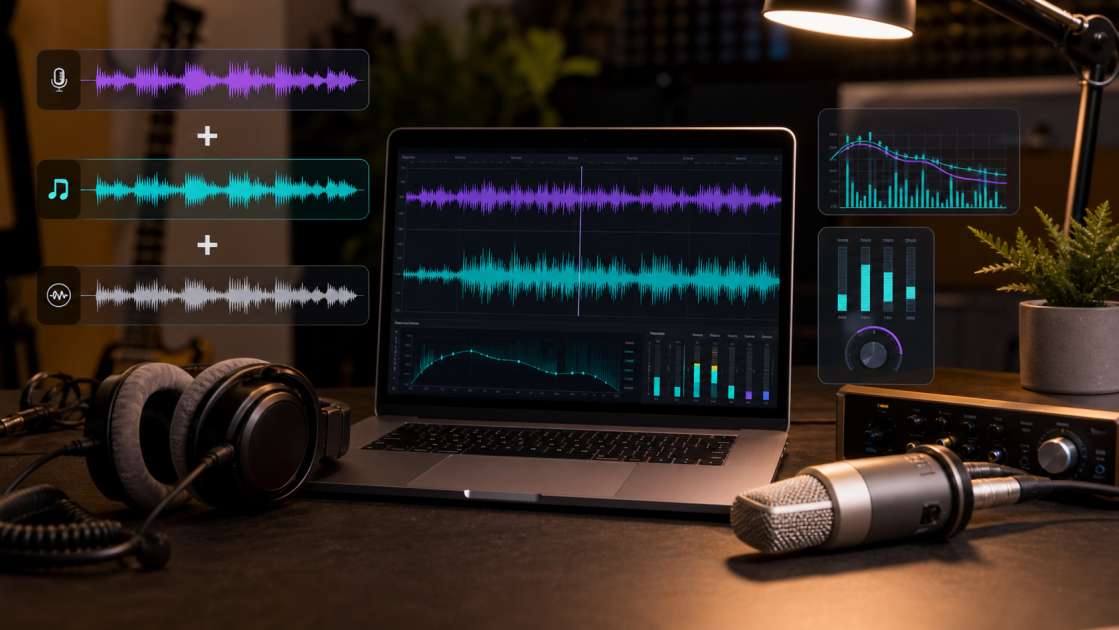
This guide focuses on listening quality, not tricks or shortcuts. The goal is simple: make a Suno or AI-generated track clearer, less harsh and easier to enjoy without removing the character that made the idea worth keeping.
In practice, small production choices that make generated vocals feel less stiff. You do not need a huge studio chain for every file. You need a good source, honest monitoring and a clear order of operations. If the melody is wrong, regenerate it. If the vocal is fake-sounding but emotionally right, clean it. If the master is just quiet, master it after the mix is already healthy.
What the problem usually sounds like
Identical phrase endings. This is the kind of flaw that can distract a listener even when the song idea is strong. Notice where it happens, whether it appears in every section, and whether it belongs to one stem or the full mix.
Overclean tuning. This is the kind of flaw that can distract a listener even when the song idea is strong. Notice where it happens, whether it appears in every section, and whether it belongs to one stem or the full mix.
Flat dynamics. This is the kind of flaw that can distract a listener even when the song idea is strong. Notice where it happens, whether it appears in every section, and whether it belongs to one stem or the full mix.
Unrealistic sibilance. This is the kind of flaw that can distract a listener even when the song idea is strong. Notice where it happens, whether it appears in every section, and whether it belongs to one stem or the full mix.
Lifeless pauses. This is the kind of flaw that can distract a listener even when the song idea is strong. Notice where it happens, whether it appears in every section, and whether it belongs to one stem or the full mix.
Before you open any cleaner
Start with the best version of the track. If you can export WAV, use WAV. If you only have MP3, do not keep converting it back and forth. Make a copy of the original and name your working file clearly. Good file discipline sounds boring until you need to undo a bad processing chain.
Listen once from beginning to end without touching anything. Then listen again and write down timestamps: where the vocal turns metallic, where a click appears, where the chorus gets crowded, where the low mids feel cloudy. Cleanup gets much easier when the problem has an address.
A practical cleanup workflow
Step 1: Choose a generation with a believable performance. Keep this step focused. Do not solve five problems with one plugin. A narrow fix is usually more transparent than a broad one, especially with AI-generated audio where artifacts can sit in small frequency zones.
Step 2: Keep a little dynamic movement. Keep this step focused. Do not solve five problems with one plugin. A narrow fix is usually more transparent than a broad one, especially with AI-generated audio where artifacts can sit in small frequency zones.
Step 3: Soften tuning instead of hard-correcting it. Keep this step focused. Do not solve five problems with one plugin. A narrow fix is usually more transparent than a broad one, especially with AI-generated audio where artifacts can sit in small frequency zones.
Step 4: Shape consonants with de-essing. Keep this step focused. Do not solve five problems with one plugin. A narrow fix is usually more transparent than a broad one, especially with AI-generated audio where artifacts can sit in small frequency zones.
Step 5: Use automation to make phrases breathe. Keep this step focused. Do not solve five problems with one plugin. A narrow fix is usually more transparent than a broad one, especially with AI-generated audio where artifacts can sit in small frequency zones.
Useful tools and when to use them
| Problem | Tool type | Safe starting move |
| Clicks or pops | Manual repair or click remover | Fix the exact transient before touching the whole mix |
| Harsh highs | Parametric EQ or dynamic resonance control | Cut a narrow band by 1-3 dB and compare |
| Muddy tone | EQ | Try a gentle cut around the low mids instead of boosting treble |
| Robotic vocal edge | De-esser, pitch tool, light saturation | Process only the vocal stem when possible |
| Quiet master | Limiter and loudness meter | Raise level after cleanup, with a safe true peak ceiling |
How to avoid over-processing
The common trap here is confusing human with lo-fi; a natural vocal can still be clean, bright and polished. It happens because every repair sounds impressive for the first few seconds. After a minute, the track may feel smaller, flatter or less emotional. That is your sign to back off.
Use A/B comparison constantly. Match the volume between the original and the processed version, because louder almost always feels better at first. If the processed version only wins because it is louder, it is not really cleaner.
Another useful rule is to process in context. A vocal artifact that sounds terrible in solo mode may disappear when the full mix plays. On the other hand, a tiny click may be invisible in a waveform but painfully obvious on headphones. Trust both your tools and your ears, but make them check each other.
When to regenerate instead of repair
Some problems are not audio quality problems. A wrong melody, weak chorus, awkward lyric rhythm or confused arrangement usually needs a new generation, not a cleaner. Repair tools are excellent for polishing good material. They are poor at turning a bad performance into a good one.
If a section has several stacked problems, try generating a few alternate takes before spending an hour repairing it. Often the fastest professional move is to choose a cleaner source and save your processing time for the version that already has musical promise.
Final checklist
Export the cleanest source. Mark the defects. Work on stems when available. Fix clicks before tone. Cut mud before adding brightness. Use light vocal processing. Master only after cleanup. Check on headphones, speakers and a small phone speaker. Keep the version that feels musical, not just technically clean.
The best cleanup workflow is not the most dramatic one. It is the one that leaves the listener thinking about the song instead of the process. Save the original, make small moves, compare often, and stop when the track feels clearer rather than merely more processed.